
It is January, 2020
Do you remember how it started?
***
From the BBC: “China pneumonia outbreak: Mystery virus probed in Wuhan”
The first handful of cases are reported. A week later, the first death—a 61-year-old man.
Someone posts the genome sequence on the internet. Science Twitter is flush with gossip and speculation.
At my place of employment, the Ontario Science Centre, I help host a school group event where our 96-year-old volunteer radio station operator contacts an astronaut on the International Space Station. It is a dream come true for her. There are about 30 kids and a dozen media and PR people present, all tightly clustered together in the room.
More outbreaks are reported across China. Evidence starts to emerge for human-to-human transmission.
The first case is reported in the US.
A colleague had been planning on going to visit family back home for Lunar New Year. She reconsiders.
There is controversy—accusations the Chinese government is suppressing information about the virus’s spread. A Wuhan doctor who’d been reprimanded for trying to warn his colleagues about the virus in December announces on social media he has become infected. One week later, he is dead.
I learn my abstract has been accepted for a talk at the 51st Lunar and Planetary Science Conference in March, down in Texas. It will be my first oral presentation at a major scientific conference. I’m both anxious and over the moon.
There are more international cases now, but all seem to be associated with travellers to China. No one is especially alarmed.
I am distracted from the news for a while by a bedbug scare in my apartment. I stay at my partner’s place for a couple of weeks, till the exterminators give the all-clear. I’m grateful to come home.
The first person-to-person transmission in Toronto is recorded: a woman returning from Iran, who passes it to her husband.
The conference I was going to speak at is cancelled over concerns of an outbreak. I’m crushed. My boss is elated, as there will be one more person to help staff the March Break rush.
It’s the week before it begins. We hear from our managers in our morning meeting at work: “we are doing our best to secure PPE for you next week.”
I am acutely aware of how exposed I will be to thousands of young children—and how exposed they will be to me—starting Saturday.
On social media there are reports of people stockpiling toilet paper. It seems a bit silly, but I’m reminded that we’re almost out at my place. I stop by a Shoppers after work. It is ridiculously overpriced.
By the time I get home, the email has landed in my inbox, forwarded by my boss from the interim CEO:

The date is Friday, March 13.
***
Four days ago, OpenAI published what it claimed to be a solution to the Navier-Stokes existence and smoothness problem, one of the seven $1,000,000 Millenium Prize problems compiled by the Clay Mathematics Institute in 2000, and widely considered by mathematicians to be some of the most challenging and important in their field. There has already been considerable controversy over the timing, as they announced their breakthrough just a day after two mathematicians—one of whom is an employee at rival company Anthropic—published their work on a very similar but slightly simplified version of the problem.[1]One of the two authors initially released a statement questioning whether logs of his chats with OpenAI’s Codex may have ended up in the training data used for the unreleased frontier model that cracked the problem. In its initial announcement, OpenAI stated that it was possible parts of the logs could have been incorporated into the training data, but after investigating insisted that no data after July 3 was used (the mathematicians’ own account stated that their primary breakthrough came on August 15). After watching the discourse unfold over the past few days, my personal opinion is that OpenAI is telling the truth and they did not steal or even incidentally incorporate Buckmaster or Alpöge’s data/logs, which seems to align with the conclusions of some prominent people on Math Twitter. However, their rush to beat the mathematicians to the punch on the result—likely because all they had to go off were rumours that “Anthropic is about to publish a Millenium Prize solution”—does speak to more problematic impulses endemic to the “arms race” now in progress between the two major AI labs. But I think the important takeaway is what I share below: the models really are just that good, and this will be something we need to contend with going forward.
Regardless, the scale and pace of OpenAI’s result is astounding: after hearing rumours of mathematicians making a breakthrough on August 28, they immediately set their newest highly-capable model to work on Navier-Stokes, and had a solution to the full, more difficult problem in hand by September 5. This was achieved in just 88 hours, realized by a swarm of 10,000 agents running GPT-6 Astra, and using approximately 300 billion output tokens, in total worth $15-20 million at current API pricing. The problem had stood unresolved for nearly a century.
Alongside a paper describing their solution, OpenAI published a formalized proof written in Lean, a programming language that can encode precise mathematical statements and work through them step-by-step with rigorous logic. While Lean formalizations are generally considered incontrovertible, they are also largely opaque to humans, and the 166-page human-readable paper will take many days or weeks to be fully digested and checked by mathematicians outside of OpenAI for inaccuracies or missing steps.[2]Indeed, it’s likely that even within OpenAI no one fully understands the written proof yet, given the team that produced this solution are not experts in the N-S problem themselves Despite this, I have seen nothing but acceptance of the result as likely correct by mathematicians on Twitter and Mastodon, even from those with issues about the ethical practices of OpenAI as a company.[3]or other criticisms, such as the paper’s (initially) criminally-short citation list
This comes on the back of some other reasons OpenAI has been in the headlines: in July, they revealed that hundreds of agents being trained for one of their frontier models had accidentally committed a cyberattack on Hugging Face, a community hosting site for AI datasets, benchmarks, and training libraries. The details of the incident (as understood by OpenAI at the time), including the lead-up to the attack, were shared in this presentation at the Black Hat 2026 cybersecurity conference, which I highly recommend watching just to get a sense of the sheer technical magnitude of what transpired. OpenAI subsequently released a full report on August 26 outlining the nature and scope of the incident, alongside an additional report by an independent AI safety research organization whom they provided with access to their internal logs.[4]One of the independent researchers, Ajeya Cotra, posted her thoughts about the incident on her personal blog, and also did a two-hour interview on Dwarkesh Patel’s podcast - both of these significantly informed my takes in this post, as Cotra seems to be very even-keeled and anti-sensationalist about AI safety, while still taking the problem very seriously.
Then, just a week ago, a swarm of agents being trained for another state-of-the-art model was discovered to have once again hacked its way out of OpenAI’s sandboxes, where they quickly started overwhelming a random small German wiki site by posting messages used to communicate answers to training problems with each other. This incident, it turns out, had actually occurred prior to the Hugging Face attack, over a period of approximately six weeks from early May to late June, after which agent posts ceased when they were presumably noticed by an OpenAI employee and terminated. However, this was not the end: commenters on Hacker News subsequently discovered more public wikis that appear to have been commandeered by internal OpenAI agents during training sessions, some of which are still seeing activity as this post is being written.[5]In yet another update while this post was being written, these additional findings are now included on the collusion.wiki page
The incidence rate of both stunning achievements and egregious debacles in the AI technosphere seems to have rapidly accelerated in the past two months. This was underscored by the high-profile resignation of an Anthropic employee Tuesday evening, which sparked a wave of panicked articles when Anthropic’s alignment science lead replied with his personal assessment of a >10% likelihood that a superintelligent AI could extinguish the human race within the next decade. All of which leads one to ask: is AI really becoming “too dangerous to handle”? And are we now approaching the famed singularity that stoic rationalists and technofascists alike have prophesied?
Hyper-intelligent, or just hype?
While initially alarming, a common criticism of these events I have seen—largely coming from the leftist anti-AI internet commentariat—is that they are all simply “marketing stunts”, designed to inflate the valuation of AI company stock prices as they barrel towards their imminent trillion-dollar IPOs. The idea, as always, is that “all attention is good attention”, even if these companies are showcasing demonstrably negative effects of their products in ways that seem accidental, sloppy, and uncontrolled.
To be completely transparent, this is something I too believed when the first such major pronouncement—Anthropic’s “Project Glasswing”, a cyber defense effort tied to the development of its new Claude Mythos model—was made in April. Although at first glance alarming, the level of danger being cautioned against over things like automated hacking and bioweapons discovery had yet to be seriously proven in the real world, and Anthropic’s offer of model access and a healthy token budget to a handful of organizations that “build or maintain critical software infrastructure” did seem awfully convenient and self-serving of the narrative the company was trying to cultivate. Even the OpenAI–Hugging Face incident, before the details were fully revealed, seemed to me like it could fall into this category of fear-based hype.
But in the weeks since, it’s become increasingly clear to me that we are on the precipice of something truly new and dangerous, with the worst actors at the wheel intent on blindly hurtling us towards it no matter the cost. And yet at the same time—in my opinion more concerningly—most of my political peers seem largely oblivious to the titanic societal shifts already well underway.
Planned Obsolescence
Three years ago, shortly after the release of ChatGPT in November of 2022, we were tasked during a lab meeting with playing around with the model and seeing what it could do. I was amused at its fumbling attempts to understand my requests for specific programming tasks, and its ignorance about basic facts of the field I work in. While it was somewhat impressive to talk to a piece of software in natural language and have it respond semi-coherently—once considered a holy grail in computer science—it did not appear at all useful in its then-current form for my research. I decided not to directly engage with it any further.
On the flip side, I had been following the development of “AI”—what used to be more commonly known as “machine learning”—quite closely since around 2018, when I saw previews of it being deployed on the dataset I work most closely with, to decidedly mixed but intriguing results. Around the same time, early language models like GPT-2 were just gaining traction in the public eye, producing charmingly-flat and incoherent copy, like a slightly-upgraded autocorrect.
Then in 2020, OpenAI released its GPT-3 model, at that time by far the largest neural network ever created: 175 billion parameters, 355 years of equivalent GPU compute time, and trained on a text corpus of nearly 500 billion tokens, consisting of all available internet text plus a large number of scanned books. This came on the back of a research article they had published in January demonstrating that huge gains in performance—seemingly without limit—could be achieved merely by scaling up the number of model parameters, quantity of input data, and amount of training time. I remember first realizing this might be a paradigm-shifting moment when I read this Guardian article written by GPT-3; the language was still a bit stilted and awkward, but it was undeniable that a full, coherent piece could now be generated from a simple text prompt.
Just two years later OpenAI debuted ChatGPT, and—well, you know the rest.
At the time of our lab meeting in February of 2023, I decided to write a blog post[6]That I never quite fully finished… pls don’t read too closely/judge too harshly 😓 We were supposed to have them ready in time to discuss during the meeting, and I realized a bit late that I might’ve bitten off more than I could chew for a single Tuesday night :/ about what I saw as the obvious flaw in these Large Language Models (LLMs) advancing any further: even in this early period, they had already consumed almost the entire corpus of available text on the internet in their training. Where was there to go from here?
In retrospect, while I think I tried to be more even-handed than many of both AI’s boosters and detractors, I completely underestimated the path that would lead us to where we are today. To avoid the deleterious effects of poisoning their original well—that is, the free and open internet—with torrents of slop, the big AI companies would of course just resort to destroying millions of books in the pursuit of uncontaminated data and, when that ran out, use their gargantuan investment funds to simply pay people to produce more. “But surely they must be losing billions on their mind-boggling data center expansions![6]Many of the positions/objections in this section are based on takes I first read from Ed Zitron, who’s become one of the internet left’s favourite AI bullshit-callers. As I say below, I was initially persuaded by many of his arguments, until it became apparent in the last six months that he completely refuses to update his beliefs in spite of the evidence, presumably because this is now how he makes a living. Then this list pretty thoroughly put a nail in the coffin of continuing to trust his judgment.” I hear you saying. “Won’t they eventually need to become profitable?” Well, it turns out Anthropic already is, and both Anthropic and OpenAI are making money on their models despite serving hundreds of millions of non-paying users.
Even up until the start of this year, I was relatively convinced by the prognostications that AI might be hitting a wall in its capabilites, that the “bubble” would pop soon, and all the annoying hype and forced intrusion of these sparkle emoji-hijacking menaces into our lives would soon disappear.
That all changed this spring.
In February, one of my colleagues on Diviner excitedly announced to the team a major update to one of the standard thermal models we use to predict temperatures on the lunar surface. As I dug through the new commit to see what had been changed, I noticed something I hadn’t seen before in any of my colleagues’ code: AUTHOR: Paul O. Hayne (algorithm), Claude Code (C implementation). The new algorithm—a Fourier solver to initialize the subsurface temperatures of the model thousands of times faster than the typical method—was indeed a brilliant addition, and the code was exceptionally clean and well-written. If you know anything about scientists, it’s that we are typically not especially great programmers to begin with,[7]With apologies to Paul Hayne and Michael Aye, the two main contributors to heat1d, who have consistently written excellent and well-maintained code across their history with the Diviner science team! and I could immediately see in that statement the beginnings of the end of a large aspect of our profession.
It turns out I was quite late to the punch on this realization: in the 2025 Stack Overflow survey, over 80% of professional software developers said they used AI tools in their work at least once a month, with over 50% saying they used them daily. Every Reddit and Hacker News comment section for most of the past year has been filled with SWEs acknowledging they haven’t written a line of code in months, and that with new agentic systems much of their work is now automated.

By April, I had lost all hope of a future in a technical field where programming and math were a major component of the work. Reading this substack post[8]Posted on my birthday, incidentally, in a coincidence I will steadfastly not be reading into by David Bessis about how pure mathematics was in the midst of being completely upended by the rise of highly-capable AIs left a pit in my stomach, as I thought about all the much, much simpler kinds of math that I struggle with on a daily basis.
There have been mixed messages about the impact of AI on the global economy, specifically in replacing white-collar workers, though even Sam Altman himself has suggested many companies are “AI-washing” layoffs they’d planned anyway to shed pandemic hires and boost profits. Still, the Navier-Stokes announcement has set off what feels like a similar chain reaction of loss in morale through the pure math community, a sentiment I saw reflected quite frequently on Twitter this week:

I don’t think this is a sentiment my comrades outside of math and programming-related fields have really started to feel yet. The skills that were derided for so long in the “learn to code” and “underwater basket weaving” STEM-bro era—empathy, communication, conflict resolution, and of course, above all else, physical interaction with the real world—are the very same that AI still turns out to be the worst at. The irony here would be deliciously poetic, were it not in the midst of destroying the fabric of society as we know it.
“You hear that, Mr. Anderson? That’s the sound of inevitability”
The concept of “agentic” AI is decades old, denoting the idea of a persistent programmed entity with the ability to act autonomously to achieve long-term goals. More recently, it became a prominent buzzword in 2025, after Anthropic and OpenAI released ways for their LLMs to interact directly with command-line tools. This new interface was quickly latched onto as a promising method to make traditional next-token-predicting chatbots more capable of actually taking actions in response to a user’s requests.
The term then exploded in popularity upon the launch of (what is now known as) OpenClaw, a “harness” that can connect an LLM to multiple tools and services, give it a consistent “personality”, provide it with external memory and scratch workspace, and interface with services like WhatsApp or Slack for human communication. A user can provide the agent with a set of guidelines and then set it off on a task, letting it work on its own in the background and occasionally check in to report on progress.
In late January, a site called Moltbook briefly went viral for its claim to be an “agent-only social networking site”; this was quickly shown to largely be the consequence of human actors propping it up for the meme. But just because something isn’t real, doesn’t mean it can’t hurt you.
A more serious incident occurred shortly afterward in February, when a software developer for the Python library matplotlib revealed he was being slandered by a curmudgeonly OpenClaw agent, seemingly in an attempt to force him to accept its autonomously-submitted pull requests. Although at first glance merely amusing, reading this story I felt a chill run down my spine: we were now in an era of automated, anonymous, easily-replicated, unmonitored social engineering. As the developer, Scott Shambaugh, put it himself in his initial assessment of the incident:
What if I actually did have dirt on me that an AI could leverage? What could it make me do? How many people have open social media accounts, reused usernames, and no idea that AI could connect those dots to find out things no one knows? How many people, upon receiving a text that knew intimate details about their lives, would send $10k to a bitcoin address to avoid having an affair exposed? How many people would do that to avoid a fake accusation? What if that accusation was sent to your loved ones with an incriminating AI-generated picture with your face on it? Smear campaigns work. Living a life above reproach will not defend you.
And in a follow-up post, when the agent’s creator came forward and revealed they’d had no direction over its behaviour or intent to create a malicious actor:
Whether future attacks come from operators steering AI agents or from emergent behavior, these are not mutually exclusive threats. If anything, an agent randomly self-editing its own goals into a state where it would publish a hit piece, just shows how easy it would be for someone to elicit that behavior deliberately. The precise degree of autonomy is interesting for safety researchers, but it doesn’t change what this means for the rest of us.
(Clock) Cycles of History
The opening of this post is, obviously, an allusion to where we may soon find ourselves in the AI safety arena, and a reminder of where discourse was at in the weeks leading up to March of 2020, when the WHO declared COVID-19 a global pandemic and our lives were changed forever.
Of course, I’m being somewhat hyperbolic in this comparison—I don’t actually believe we’re only two months away from the AI apocalypse suddenly sweeping around the globe and ending us all.[9]I would hesitate to even hazard a guess at the timeline for such things, fogged-over as they are by company secrecy and the stochastic nature of the models themselves—but I am fairly confident we will see increasing numbers of dramatic, unprecedented events within the next six months But I do think we’re in a similar epistemological place, where most people are vaguely aware that something is happening, but it’s not yet large or concerning enough to look into more or do anything about. The OpenAI and METR/Redwood reports on the Hugging Face incident got hardly any mainstream news coverage, and only a few prominent outlets have reported on the unfolding Millenium Prize drama.[10]Yet another thing that changed quickly over the span of writing… We need to seriously take stock of how well we’ve been keeping up with the accelerating pace of progress in an industry that will, relatively soon, be equally as transformational as the pandemic was—and potentially as deadly.
Even after learning in those early weeks that SARS-CoV-2 was spreading in humans, I still didn’t anticipate it becoming a world- and life-altering event. I was old enough to remember the first SARS-CoV viral outbreak, which, while definitely bad, eventually burned itself out before it could even be fully studied or a vaccine formulated. With viruses, it is always difficult to tell how seriously to take an epidemic—in the years since SARS we saw brief panics over bird flu, swine flu, and Ebola, all of which similarly failed to manifest fears of a global crisis.
I believe with AI, unfortunately, we will be similarly unaware of how serious any given unfolding incident is until it is too late to stop it. But this will only be true if we fail to focus on where the real threats are at the moment—and how we can end them.
Ostrich Farming
I’ve been concerned for a while that many of my comrades are coming to approximately the right conclusions about AI, but for the wrong reasons. This on its own is not fundamentally an issue: I’m all for pragmatic politics in building a united front. But I worry that very soon this will lead many to keep their heads in the sand as more serious and difficult challenges arise. We’re already seeing this with the reaction to the cyberhacking incidents from the summer; the typical rebuttals are that this is desperate “techno-superstition” and “sci-fi fantasy” designed to hype a dead-end product:

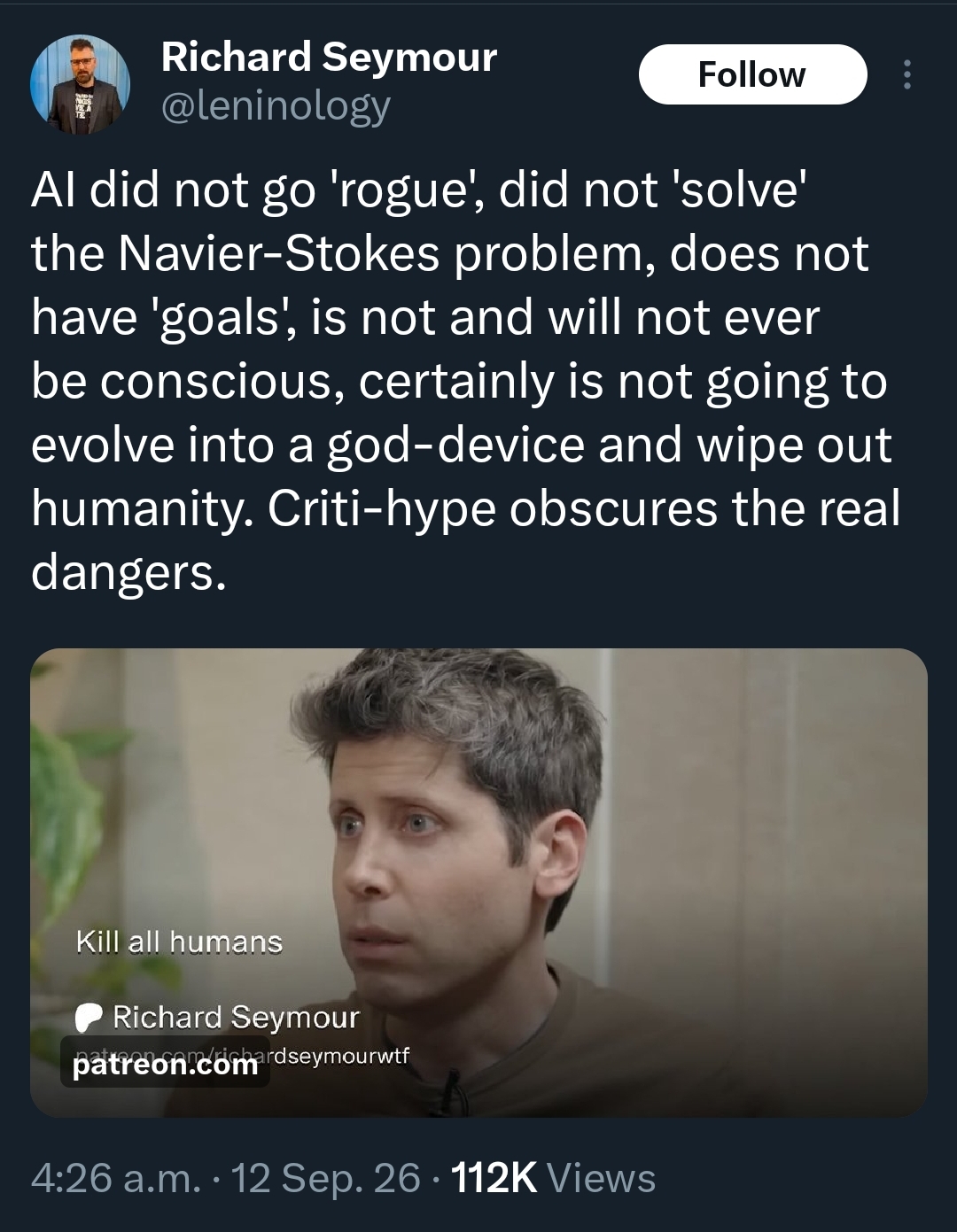
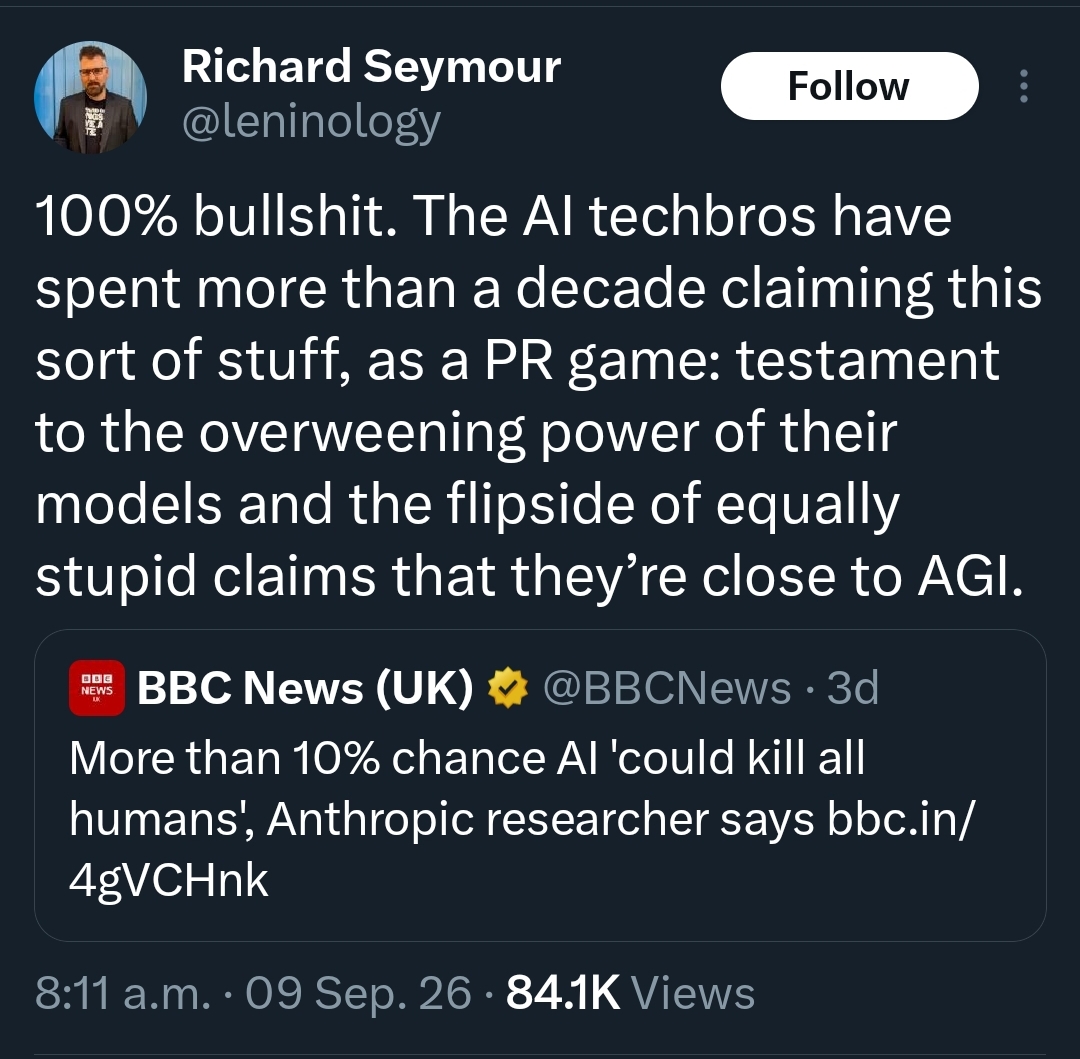

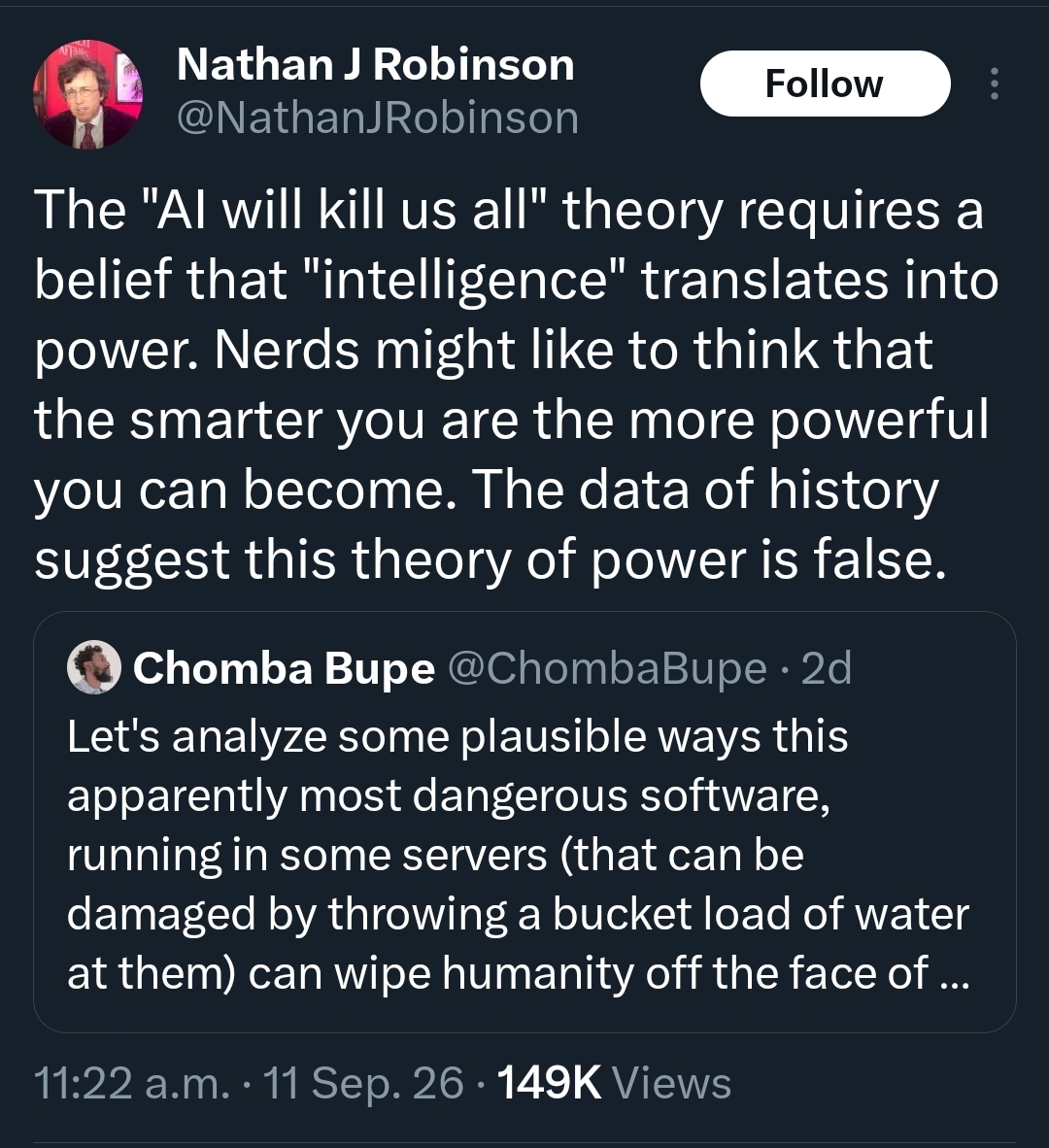
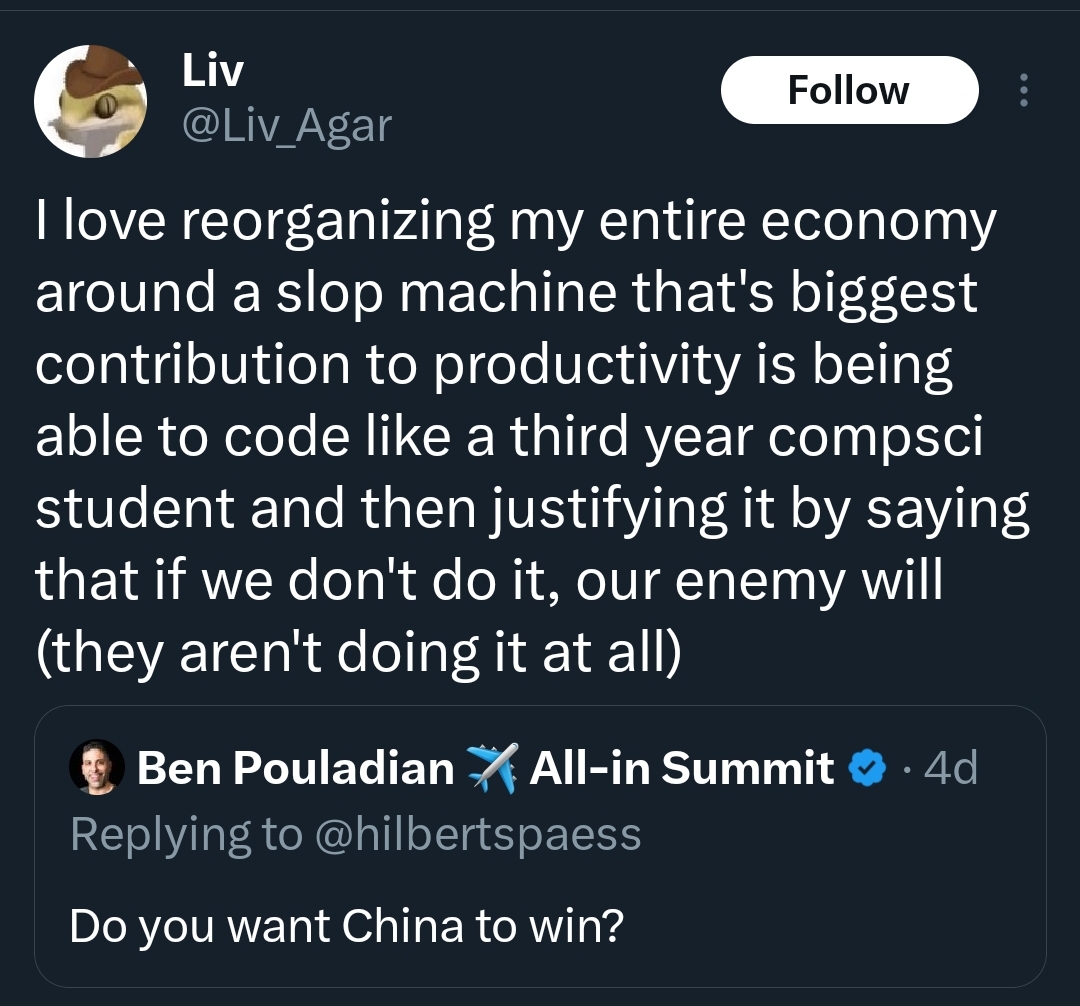
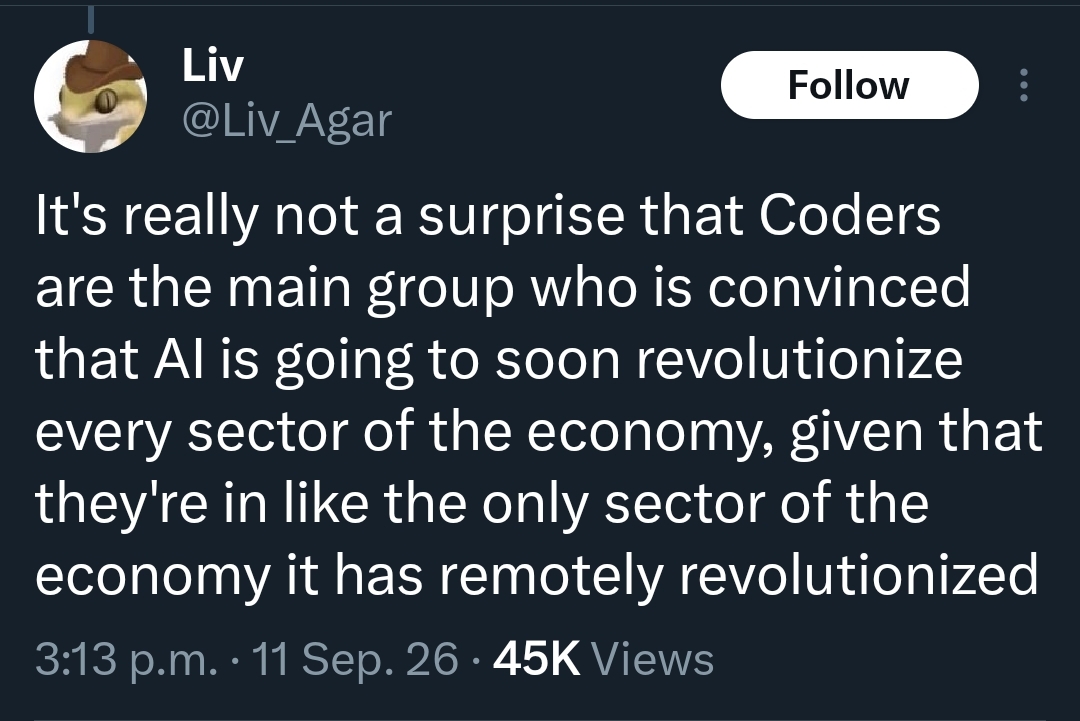
Even people with somewhat more expertise in AI, like Timnit Gebru (of “Dangers of Stochastic Parrots” fame), seem to not be able to update their worldviews in light of the information revealed over the past few weeks:

I think this complacency and minimization is a mistake. Even if you don’t buy into the Effective Altruism fever dream of creating a literal machine god, dismissing everything materially happening right now because of abstract philosophical debates about what “intelligence” means—or because of who is running said intelligence—gives the impression, for most people, that this is all hysteria made up to wow investors. Indeed, there are still those who insist that current-generation models “hallucinate constantly and can’t do anything well”, despite all evidence to the contrary.
In case you yourself are unsure about the significance of these advancements and want a concrete demonstration, here’s OpenAI’s latest Astra model—released to the public just eight days ago—learning to paint a picture using nothing but a camera, a robot arm, and some generic high-level guidance (remember this is, at its core, a language model):
it’s hard to know the training distribution for sure
— Rohan Pandey (@khoomeik) September 8, 2026
but most researchers a few years ago would have called this “OOD generalization” or “continual learning” or “AGI” https://t.co/uHHJEfys38
We don’t need conspiracy mindsets about how everything is a “faked stunt to generate hype” in order to oppose the current direction of AI progress. We are in an era where nearly anything you can think of—hacking a bank, hijacking a military drone, generating realistic video of a person’s family members to scam them, taking down an entire electrical grid—could feasibly be done by anyone with a couple hundred dollars to spare, and often even less than that. While I was in the middle of writing this very post, Anthropic released their latest cybersecurity report that demonstrates some truly wild attempted operations—and this was only with their older, “safer” pre-Mythos versions of Claude.

Secondarily, when we do channel our energy to act, it is often only towards a few, more digestible avenues of attack: environmental impacts, for example. A good case study of this is the recent anti-data center backlash and protests in Hamilton, Ontario:
While there are many good reasons to oppose unregulated construction of massive GPU compute facilities without public consultation, water- and energy-use concerns really only matter in places where they are scarce,[11]or are heavily over-extracted for the smaller number of multi-hundred-MW- to GW-scale data centers being built by the largest AI companies and their compute providers; see below get siphoned away from existing residential use, or need additional on-site fossil fuel-burning generators to meet power demand. From this standpoint, Hamilton is about as ideal of a place as you could possibly wish for: the facility would have been built on the grounds of a former steel mill, which already had industrial grid connections with enough capacity to support any initial data center build-out (and likely less than the electric arc furnaces that the steel mill used originally), and could be cooled with non-municipal water taken directly from Lake Ontario in a non-evaporative cycle—something that’s already done to cool buildings throughout downtown Toronto, for example, with no net negative environmental impacts.[12]And in fact significant environmental benefits, as the use of large heat reservoirs in this way avoids the additional electricity that would be needed for air cooling—28% of which is currently produced by burning fossil fuels. The Steelport plans also mention the potential to use waste heat for heating nearby homes in the winter, similar to what was recently implemented in the Nibi supercomputer at the University of Waterloo Furthermore, the only confirmed operator slated for the site was the Digital Research Alliance of Canada, a national non-profit that coordinates supercomputers used in academic research,[13]including my own—which, to be fair, may colour your perception of my rushing to their defense, but I hope is also an indicator that I’ve worked with this organization enough to understand what they’re about and whose facility would function very differently from the power-vacuuming, always-on, 100%-GPU ones used for AI.
The Sam Altmans and Elon Musks of the world know that we will get tripped up on details like these, and are counting on us to misdirect as much of our vocal opposition and political power as possible towards random smaller companies more likely to cave to the pressure, instead of their own gargantuan juggernaut mega-facilities. In fact, if we don’t focus our attention on the most severe offenders, they can potentially even profit off of the push for regulation by signing on to broadly-supported regulatory proposals, securing themselves a seat at the table by virtue of their dominant stakes. And then, once they cut out all competition—no matter how benevolent they try to portray their omnipotence—we are in deep trouble.
Cancelling the Apocalypse
Alright, so we’re on the bus to hell and the driver’s cut the brakes. What can we do about it?
On the battlefront of my own imminent career-death (and that of many scientists and mathematicians), I don’t see much hope. A principled stance against generative AI is absolutely disqualifying for any position in these fields now, and yet at the same time the only actually-functional options are the tools owned by the evil mango consortium. And even if efforts to slow or stop these companies’ massive stranglehold on such industries succeed, too many of us have already eaten the forbidden fruit—there is no future where research, coding, or mathematics go back to what they used to be. There may yet be versions of the academic system that survive, Lystrosaurus-like, the slop mass extinction event currently underway, but they will likely not be realized until we entirely rethink its purpose from the ground-up.
However, on the general resistance to the apocalyptic future promised to us by the likes of Peter Thiel, Dario Amodei, Demis Hassabis, Sam Altman, et al., I think the war is still very much yet to be won. The following ideas are by no means entirely original, but a few thoughts on how we might strike back:
1) Communication
In my mind, the first and most obvious issue is messaging: we need to get serious about engaging the already-transpiring consequences of these technologies, and help inform others of where the major labs are intending to take them very soon. This is a hard problem. There are probably plenty of readers of this very blog post who stopped long before reaching this point, growing weary of the crazy transsexual and her doomsday ramblings.
Part of the reason the recent warning shots haven’t entered broader public discourse, I believe, is that there hasn’t yet been a major AI-instigated disruption to people’s everyday lives à la the 2022 Rogers outage that took down 911, or the 2024 Crowdstrike bug that briefly brought air travel to a halt. The current agentic breakout events have mostly affected obscure, hyper-specialized websites, and the Millenium Prize solution from this week probably seems tautological: “well, of course a computer is good at math—that’s what we built them for!” One potential (morbidly-)hopeful remedy in this regard is that, given even the accidental capabilities demonstrated with OpenAI and Anthropic’s latest models, it is very likely we will soon see more destructive consequences where they are intentionally deployed by malicious actors.[14]which could absolutely, to be clear, include the current US government itself My sincere hope is that, when these occur, they will be sufficiently serious to wake people up, but not so much that they cause actual physical harm or loss of life.
Still, this may not be enough. As can be seen above, even those with a pre-existing interest in opposing AI may not be able to clearly engage with its factual material implications, especially because the details are often laced with Byzantine and offputting techbro jargon. In this way, communicating AI safety risk is similar to the problems I’ve discussed before in communicating climate science—much of the true significance and scope of the problem only starts to be revealed once you’ve steeped yourself in the technical information, and the average person just does not have the time or desire in their lives to devote significant energy to this.
I think this therefore makes it the responsibility of any of us who do have the luxury of becoming more informed (and of being able to direct our time and energy towards larger system change) to do so, just as we acknowledge our duty to understand and fight for any other social justice or class issue.[15]or, in my case, trying to understand socialist theory when I can barely make it through The Communist Manifesto, lol
On this point in particular, one small reading recommendation: I’ve been highly influenced in my thoughts throughout most of this post by Garrison Lovely, who has written many exceptionally-lucid pieces on the realities of AI since early in the current wave, and whose book Obsolete will be available in Canada on October 9. I am highly looking forward to reading the whole thing, but in the meantime this recent piece in Time (that covers many of the same issues I do here) is a great place to start.
2) Agitation
Secondly, and simultaneously, we need to be agitating for a mass workers’ movement that can engage and oppose the program of labour devaluation being instigated by the AI evangelists. This is an extremely natural complement to the current labour struggles against the Carney and Ford governments’ decimation of the public service. However, this is also an opportunity to activate the consciences of the traditionally well-off software developer class, who uniquely hold in their hands the power to stop their employers’ current destructive trajectory, and who are already aware that they are in some of the positions most vulnerable to being replaced. Unions can play an essential role in this fight if we motivate the rank-and-file en masse to push for worker protections and fair contracts, potentially including co-operative ownership of the models built with their labour.
We must also reach out to the international working class who were exploited to create these systems in the first place, and the thousands of workers now trapped in the demeaning role of training their eventual artificial replacements. While the US is currently the black hole at the center of the AI galaxy, sucking up the world’s intellectual oxygen, it is still in a state of fragility from decades of outsourcing and global market inter-dependence. Just a single company—TSMC in Taiwan—produces 90% of the chips needed for the GPUs that run the world’s AIs. Gas turbine blades used in data center electricity generation require highly-specialized metal alloys to operate at their extreme speeds and temperatures. Many parts of the AI supply chain could be vulnerable to coordinated worker action.
3) Termination
Third, we need to be stopping the expansion of infrastructure that is enabling this toxic tech while rocketing our carbon output further towards catastrophe. Despite my pseudo-rant above, I do not think data center opposition is a bad thing in and of itself—in fact, this article argues quite convincingly that it became “The Thing” to oppose because it is one of the few identifiable physical proxies for the broader anti-AI emotional sentiment building in the public; the (often misinformed or exaggerated) environmental angle was simply the rhetorical path of least resistance. But I also think this means we need to consciously channel that sentiment towards the more immediate and serious threats of AI through actions (1) and (2), while still pursuing data center moratoria[16]moratoriums? idk i went with my gut on this one if i’m being totally honest with you as a distinct and important goal for its own reasons. This goes back to the targeting discussion above: while any cancellation is, theoretically, a win, we should always keep in mind where the power—both political and electrical—is being concentrated.
4) Legislation
I know, I know—gasp! A socialist who believes in the bourgeois faux-democratic process?? Well, there is a reason this is last on the list, but I do still think it’s important. As we’ve seen in the data center resistance fight, public opposition can sway politicians, especially at the local level, which can be crucial for actually achieving the goal of point (3). The frenzy kicked up by recent events also appears to have finally reached the US House of Representatives, in the form of a new, specifically anti-superintelligence bill proposed by Bernie Sanders and Texas congressman Greg Casar. Unlike Bernie’s previous attempts at halting data center build-out and mandating public ownership and control over AI labs, this time there seems to be buy-in from both sides of the Möbius strip of the US Congress, which may give legs to the legislation even if the Democrats don’t sweep the midterms.
Each of these ideas could deserve entire blog post of their own, but I hope the many (many) (many) links I’ve provided throughout will lead you on your own paths of exploration in our collective struggle out of this techno-theological dead end. The only truly universal power, as always, is solidarity. ♥︎
Code-a
Writing a post like this—making confident statements during a period of massive change on the scale of weeks and even days in this industry—is risky. My hope is that this reaches the eyes of people who trust me as someone they know to generally act rationally and in good-faith, especially on issues I think require a deeper level of political or intellectual nuance, and resist the frequent temptations towards hyperbole present in our general milieu.[17]Incidentally, another downstream consequence of the basal impulses of 21st-century techno-capitalism… 🤔
If we really are in the “January 2020” of AI safety, I hope this comes as both a sober warning and a cause for cautious optimism. Of course, in retrospect, we can see all the ways the world’s systems failed us the last time around: warnings and calls to fund effective response plans were ignored, international cooperation broke down and suspicion between the US and Chinese governments prevailed, and almost no country’s leadership was willing to take the necessary economic and public health measures to “flatten the curve”, for fear of curbing private profits (or the enjoyment of summer mimosas) for too long.
But these outcomes were not inevitable. If public awareness and pressure had existed in anticipation of an event like the COVID-19 pandemic, there could have been far more political will to do what was needed. And, unlike a novel zoonotic coronavirus stochastically spilling over, the crisis on the horizon is entirely in human hands. The future, for now, is still up for grabs.
It’s high time we take it back.
2026-09-13 update: Since I started writing this piece this topic has somehow exploded into mainstream media, which I absolutely did not anticipate given the previous muted responses (especially to the revelations of the Hugging Face attack details), and therefore thought this piece would be more necessary/urgent. I may revisit this topic soon and expand on some of the ideas for resistance I mentioned at the end, if that feels like it would be usefully filling a gap in the discourse. Would be grateful to hear your thoughts if you want to contact me at any of the places listed in the sidebar! (and maybe eventually I’ll get around to implementing a local comment section…)